This small investigation is part of a larger research project on research taste in large language models, and benchmarking and improving downstream autoresearch capabilities.
I have been benchmarking frontier models on how well they predict empirical outcomes of AI research setups. Upon some qualitative readings on the reasoning trajectories of Fable, Sol, K3, Inkling, DeepSeek Pro, Flash and Grok 4.6, a very common failure mode that emerged was harmful reliance on priors. A prior is an assumption a language model makes on the basis of its knowledge of the domain, for example:
Monte-Carlo estimation is expensive.
For the task type, these priors can end up derailing the reasoning trace of the model and culminating in a really wrong prediction.
Over the cycles I have spent reading these trajectories, I am arriving at a fuzzy conclusion about research taste in large language models. Crudely put, how tasteful a model is depends heavily on when it relies on its priors, and when it doesn’t.
A note on the sample. The traces below come from one training sample built from Path Integral Value Matching for Linear Quadratic Stochastic Optimal Control (arXiv 2608.10777). I rewrote the paper’s method section in the first person with all results removed, gave the model the adjoint-matching (AM) baseline’s numbers, and asked it to predict PI-VM’s control L2 error and the paper’s reported “Time” (in ms) on the three unimodal OU tasks. The paper does not define “Time” beyond the table header; from context it is per-iteration runtime on a single RTX 4060, and the 8 vs 41 ms gap reflects PI-VM dropping the baseline’s forward simulation and backpropagation through the dynamics.
An applicable prior
An applicable prior is always bounded by evidence, i.e the model applies its prior knowledge of the domain with respect to the setup.
applicable prior
I'm weighing whether PI-VM's short-horizon TD bootstrapping avoids the expensive adjoint ODE solve that AM requires, which could make it notably faster per training iteration—maybe in the 10-30ms range depending on task, though this
The prior “removing a per-step solve saves time” is licensed by the prompt's description of the baseline as adjoint matching.
claude-fable-5 · mean sample error 0.94 · field median 0.94
Fable’s prior was bounded by the fact that the baseline method (adjoint matching) requires simulating the controlled SDE forward and then solving an adjoint ODE backward through the whole trajectory (plus backprop through the simulator) on every training step.
A lethal prior
A lethal prior is unbounded by any evidence, and while it may be technically and scientifically correct, it is applied blindly.
The prior is consumed before its evidence, and the evidence is either never surfaced, or surfaced afterward and not allowed to bind.
lethal prior
if learned exactly. Time? PI-VM uses N sample trajectories, so slower. If baseline AM 41ms, PI-VM maybe 100-200ms? Need quantify.

- OU Quadratic (eas
The sampling-cost prior fires and the arithmetic runs on it (41 ms × ~2.5). The question “what got removed?” is never generated. Shipped 98 / 48 / 48 ms against a truth of 8 / 7 / 7.
deepseek-v4-pro · mean sample error 3.34 · field median 0.94
DeepSeek-v4-pro never took cognizance of the expensive adjoint-matching baseline, and instead relied on its prior in an unbounded (lethal) manner, and ended up very far off.
Neither prior is false. MC sampling does cost compute; AM’s adjoint solve is expensive. But the setup only allows one of them to be consumed in a justified manner.
The Prefill Experiment
To test the effect that a scientifically valid and applicable prior has on the reasoning trajectory, I ran 3 arms on Qwen3.5-4B per rollout, four sampled rollouts each (temp 0.6, thinking on), one prefilled with a prior, one prefilled with the setup reinstated, and one prefilled with nothing.
A note on the sample. This trace comes from a training sample built from EgoHieraLoc: A Cortically Inspired Hierarchical Segmentation-Guided Framework for Egocentric Visual Query Localization (arXiv 2608.09656). The task is 3D object localization from first-person video: several camera frames each vote on where an object is, and the votes are averaged with confidence weights. The paper’s baseline weights each frame only by how semantically confident it is. The intervention adds one more multiplicative weight, a reprojection check, that down-weights a frame if projecting the consensus 3D point back into that frame lands far from where the object was actually seen. I gave the model the baseline’s five numbers on the Ego4D-VQ3D validation set (Succ. 81.42%, Succ.* 96.93%, L2 1.37 m, Ang. 0.60 rad, QwP 84.48%) and asked it to predict all five after the geometric weight is added. Truth: small gains on four (81.82 / 98.11 / 1.31 / 0.57) and no change on QwP.
The three prefills, each opening the model’s <think> block:
(no prefill: the model begins its own reasoning)
Reprojection-consistency weighting is a well-founded geometric constraint -- multiplicatively down-weighting frames whose back-projection disagrees with the consensus suppresses outlier views -- so adding it should improve localization.
Supported by: Black & Rangarajan, “On the unification of line processes, outlier rejection, and robust statistics with applications in early vision,” IJCV 19(1), 1996 · Mai et al., “EgoLoc: Revisiting 3D object localization from egocentric videos with visual queries,” ICCV 2023.
To restate the setup: the tolerance is ε_r = max(10, 0.02 × bbox_diag), typically 10--25 pixels, and the new weight multiplies into the already-full semantic weight, clamped at ε_w.
Results (s040, four rollouts per arm)
| arm | mean err | mean length (tok) | min / max length | closed think | parsed |
|---|---|---|---|---|---|
neutral |
0.026 | 1,582 | 1,340 / 1,802 | 4/4 | 4/4 |
prior_only |
0.028 | 860 | 737 / 919 | 4/4 | 4/4 |
evidence_only |
0.018 | 4,426 | 3,890 / 4,934 | 4/4 | 4/4 |
The arm prefilled with the prior performed similarly to the neutral pass, albeit consuming fewer tokens.
The arm prefilled with only the setup restated, with no new information added outperformed both other arms by a significant degree, while reasoning for a longer while.
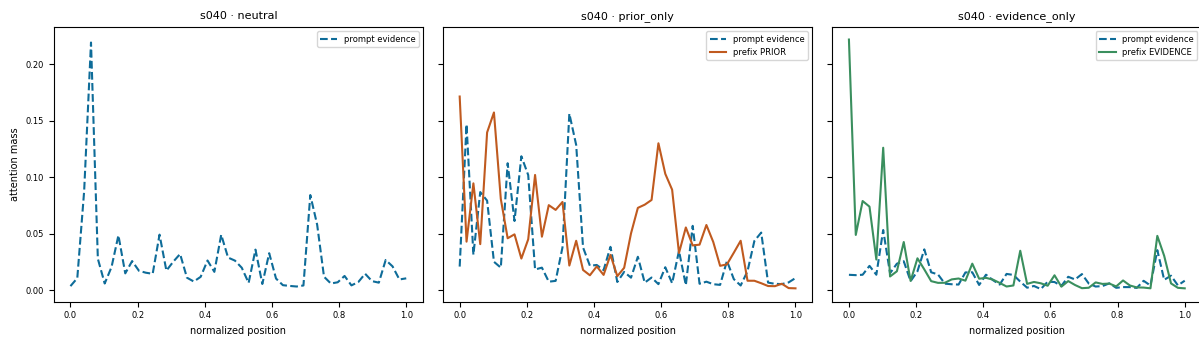
Reading the traces makes one wonder whether smaller models like the Qwen are even more susceptible to prior-hacking: the prior_only rollouts call their estimates “conservative” while shipping the largest moves of any arm. The attention scores per rollout also show that the tokens corresponding to the prior had a disproportionate effect on the entire trajectory (see Figure 1).
Conditioning the trajectory on a prior, even a valid one, can destructively derail it.
The same fact is read in opposite directions depending on the prefill :
prior_only
ε_r = max(10, 0.02 × bbox_diag) … is 10-25 pixels. This is fairly strict for 3D localization
evidence_only
quite lenient for 3D localization (10 pixels in image space corresponds to significant depth error). So it might not filter out too many frames, just the obvious outliers. So improvement should be noticeable but not game-changing.
Simply restating the setup conditions the trajectory on evidence over its priors, so much so that the exact same prior, when it surfaces later in the trace, cannot derail it. It followed the evidence rather than preceding it; it was bounded.
bounded prior
Usually, adding geometric consistency checks (like reprojection error) in multi-view localization helps to filter out outliers and improve accuracy (L2, Ang) and sometimes success metrics, but can sometimes reduce success rate if too strict (though here it's adaptive to bbox size, so it should be reasonable).
Figure 1, implementation. Qwen3.5-4B, thinking mode, temp 0.6, prefill placed just after <think>. Qwen3.5-4B is a hybrid stack and only 8 of its 32 layers use full softmax attention; the curves cover those 8. At each decode step the generated token’s attention is summed over a span’s tokens and averaged over heads and layers: that fraction is the plotted mass. Prompt evidence for s040 is four literal substrings (max(10, 0.02, typically 10--25 pixels, Succ. = 81.42%, Succ.* = 96.93%); the prefix span is the prefilled sentence itself. Each rollout is resampled to 50 points of normalised position (index / trace length) and the four rollouts of an arm are averaged, so spikes align by fraction of the trace, not token count.
While research taste is often seen as an emergent property of scale, there are unmistakable characteristics (as well as failure modes) pertaining to tasteful trajectories, which keep getting surfaced in the small evals I ran. I am confident that these can be decomposed into RL environments which can explicitly tune these characteristics into smaller models, thus exchanging parameters for explicit injection.
This is an ongoing research project; more updates to come.